Biography
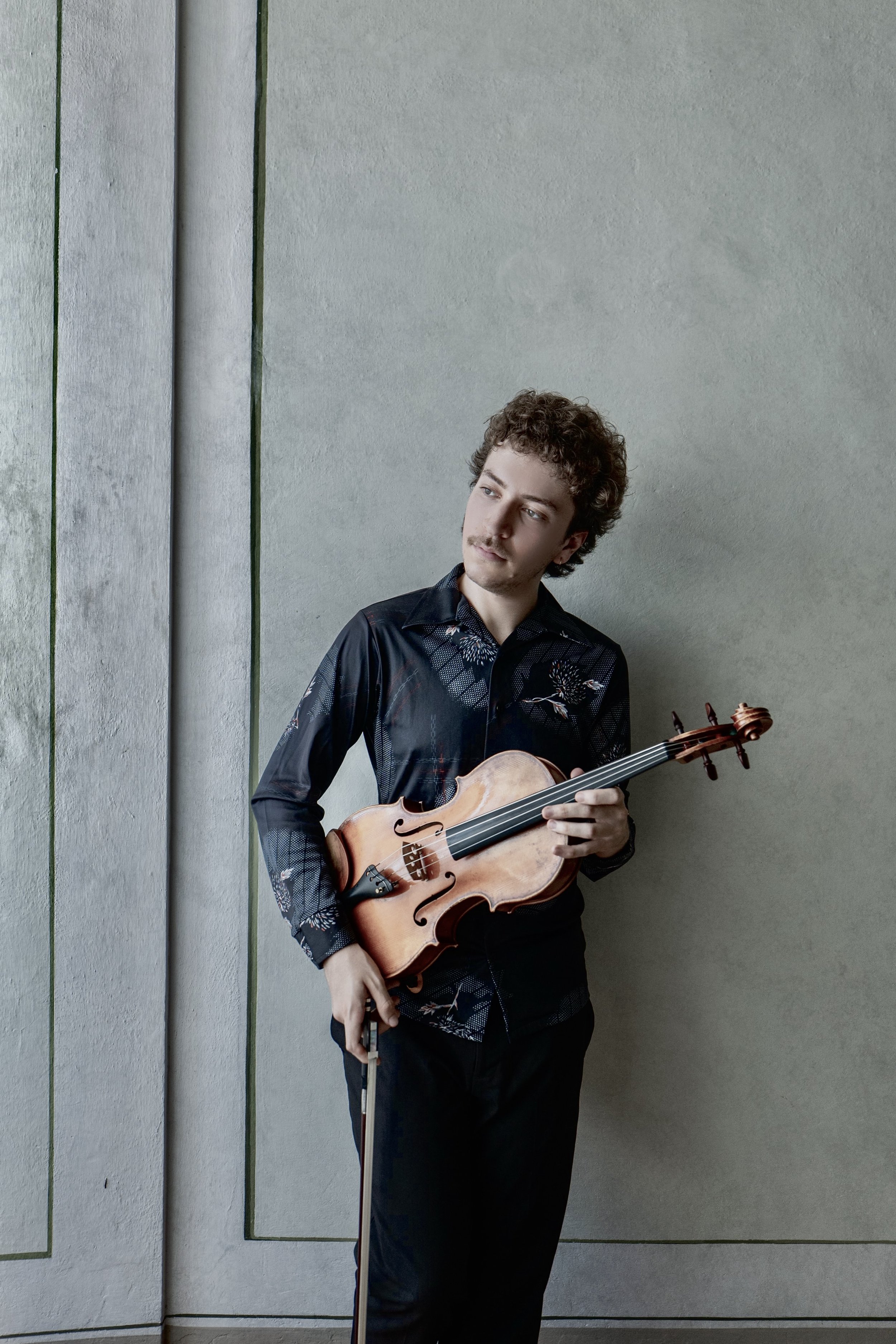
Praised for having “exuded a rare warmth,” Mexican-American violist Nic Perkins is a multifaceted musician whose musical life has been shaped by collaboration, artistic process, and the continual, never-ending discovery that comes through making music with others.
Nic is currently pursuing a Master of Musical Arts degree at the Yale School of Music, where he studies with Ettore Causa. He received his Bachelor of Music from The Juilliard School, where he studied with Hsin-Yun Huang. He has participated in many of the world’s leading young artist programs and festivals, including the Verbier Festival Academy, Kronberg Academy Masterclasses, IMS Prussia Cove, NUME Festival and Academy, Gstaad Menuhin String Academy, Four Seasons Chamber Music Workshop, Perlman Music Program Chamber Music Workshop, Taos School of Music, and the Kneisel Hall Young Artists Program.
As a chamber musician, Nic has collaborated with members of the Juilliard, Brentano, Borromeo, Cavani, Cooperstown, Shanghai, and Hagen String Quartets, as well as artists including Ida Kavafian, Nicholas Kitchen, Nina Lee, Michael Kannen, Molly Carr, and Vivian Weilerstein. At the Aspen Music Festival, he has performed alongside Jory Vinikour, Matthew Lipman, Timothy Ridout, Paul Huang, and Elaine Douvas in multiple concert cycles of Bach’s Brandenburg Concerti. In recent times, he performed at the Verbier Festival in Église de Verbier, Prussia Cove Spring Concerts in Cornwall, Juilliard’s “Now” concert series at Lincoln Center and Chelsea Factory, and a performance with the Cassatt Quartet at Bargemusic featuring the premiere of Allen Shawn’s Piano Quintet. He has also participated in the “Taos on Tour” outreach initiative, bringing chamber music to communities throughout the region.
Nic’s musical development has been shaped by working with leading violists including Tabea Zimmermann, Nobuko Imai, Antoine Tamestit, Kim Kashkashian, Lars Anders Tomter, Paul Coletti, Misha Amory, Donald Weilerstein, among others. He is honored to be a Virtu Foundation Scholar. He performs on a viola by Joseph Grubaugh & Sigrun Seifert, generously loaned through the foundation— and with a bow provided by the Maestro Foundation.
Outside of music, Nicolas enjoys cooking, discovering new coffee shops, listening to a variety of podcasts, watching video essays, and spending time alone in nature.